

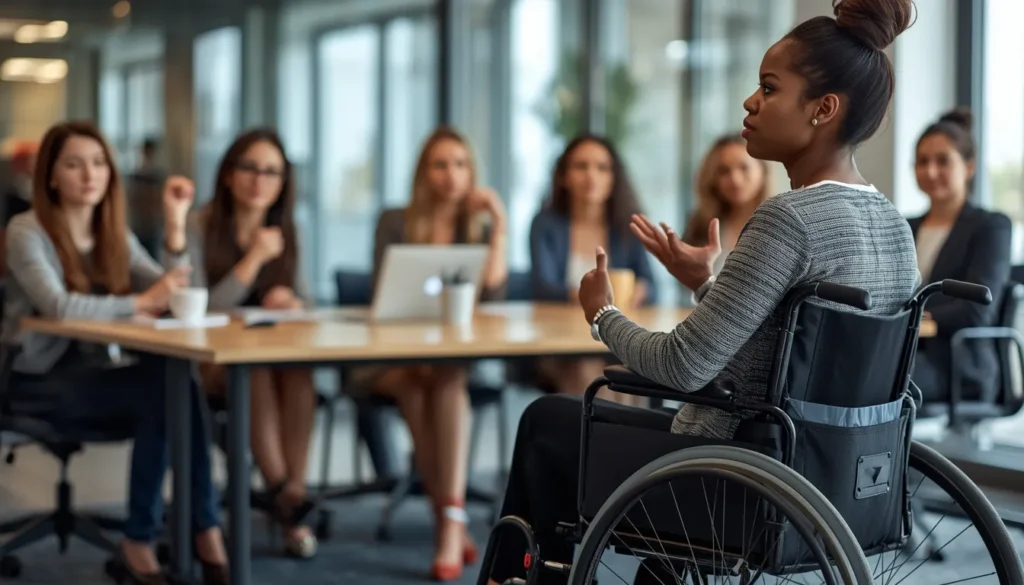
The Intersection of Women’s Rights and Disability Advocacy
The fight for equality has many dimensions. Among the most important—and often overlooked—is the intersection between women’s rights and disability advocacy. Women with disabilities face unique challenges that are shaped not only by gender inequality but also by ableism. Understanding this intersection is essential to building a more inclusive and equitable society.
True equality cannot exist if it excludes those who experience layered forms of discrimination.
Understanding Intersectionality
Intersectionality is the idea that people can experience overlapping systems of discrimination based on identity factors such as gender, disability, race, or socioeconomic status.
For women with disabilities, inequality may appear in multiple forms:
- Gender discrimination
- Limited accessibility
- Economic disadvantage
- Healthcare barriers
- Social stigma
These challenges do not operate separately — they compound each other.
Key Challenges at the Intersection
1. Economic Inequality
Women already face wage gaps globally. Women with disabilities often encounter:
- Higher unemployment rates
- Workplace discrimination
- Limited access to career advancement
- Lower overall lifetime earnings
The economic impact is significant and long-lasting.
2. Healthcare Barriers
Access to healthcare can be particularly complex for women with disabilities.
Barriers may include:
- Inaccessible medical facilities
- Lack of specialized reproductive healthcare
- Dismissive attitudes from providers
- Limited mental health support
Reproductive rights and disability rights frequently intersect, yet policy discussions sometimes treat them separately.
3. Increased Risk of Violence
Research consistently shows that women with disabilities face a higher risk of physical, emotional, and sexual violence.
Contributing factors include:
- Dependence on caregivers
- Communication barriers
- Social isolation
- Inadequate legal protection
This makes protective services and reporting systems critically important.
4. Representation and Visibility
Women with disabilities are often underrepresented in:
- Media
- Leadership roles
- Policy discussions
- Advocacy movements
Without representation, policy decisions may overlook lived experiences.
Why Inclusive Advocacy Matters
Women’s rights movements must actively include disability perspectives. Similarly, disability advocacy must address gender-specific issues.
Inclusive advocacy ensures:
- Policies consider accessibility from the start
- Economic programs address layered inequalities
- Healthcare systems are responsive to diverse needs
- Public spaces are safe and accessible for all women
When movements work together rather than separately, progress becomes stronger and more sustainable.
Building a More Inclusive Future
Creating change requires action at multiple levels:
Policy Level
- Strengthening anti-discrimination laws
- Expanding workplace accessibility standards
- Protecting reproductive and healthcare rights
Community Level
- Encouraging inclusive education
- Supporting disability-led organizations
- Promoting representation in leadership roles
Individual Level
- Listening to lived experiences
- Challenging stereotypes
- Advocating for accessible environments
Change happens when awareness turns into accountability.
The Power of Amplifying Voices
One of the most important steps forward is amplifying the voices of women with disabilities themselves. Advocacy should not speak for them but alongside them.
Their lived experiences provide the insight needed to shape effective, compassionate policies.editation.
Final Thoughts
The intersection of women’s rights and disability advocacy reminds us that equality is not one-dimensional. It requires understanding how identities overlap and how systems of inequality interact.
An inclusive society does not prioritize one struggle over another. Instead, it recognizes that justice must be comprehensive — ensuring dignity, safety, opportunity, and representation for all women, including those with disabilities.
True empowerment is inclusive empowerment.